Commercial Drain Maintenance: What Salt Lake Businesses Need to Know
A clogged or failed drain in a residential home is an inconvenience. In a commercial setting, it can stop operations, create health code violations, and drive customers and employees out of the building. The difference between a residential and commercial drain system isn’t just scale. It’s volume, loading type, and the stakes when something goes wrong.
Utah businesses in the Salt Lake area operate under real-world drain stress: restaurant grease, high-traffic restrooms, floor drains in service businesses, and outdoor drainage dealing with seasonal snowmelt and storm events. Without a maintenance plan, the question isn’t whether you’ll have a drain problem, it’s when.
On this page
- Why Commercial Drains Fail Faster
- The Grease Interceptor
- Floor Drains
- High-Traffic Restrooms
- The Case for Preventive Drain Maintenance
- What a Commercial Drain Camera Inspection Shows
- When to Call
- Where Rare Breed Fits on Commercial
Why Commercial Drains Fail Faster
Commercial drains process significantly more volume than residential systems. A restaurant drain line sees thousands of gallons per day. A high-traffic retail restroom handles more fixture cycles in a week than a residential bathroom sees in a year.
The loading is also different. Residential drains mostly carry water and waste. Commercial drains often carry grease, food particles, chemicals, high-mineral water, and in some cases industrial compounds, depending on the business type. These substances accumulate differently and require different maintenance approaches.
Grease is the primary culprit in food service operations. Grease doesn’t stay liquid. It cools and solidifies in drain lines, coating the interior walls, catching other solids, and progressively narrowing the pipe until flow is restricted or completely blocked. A restaurant without a grease management program will have drain problems. It’s not a question of if.
The Grease Interceptor
Any food service business that discharges cooking grease into the sewer system is required to have a grease interceptor (also called a grease trap). The interceptor sits in the drain line between the kitchen and the municipal sewer, captures grease before it enters the sewer system, and allows grease-free water to pass through.
Grease interceptors must be pumped and cleaned regularly, with frequency depending on the volume of cooking at your operation. A high-volume restaurant may need pumping monthly. A lower-volume operation may manage with quarterly service. The health department and your grease interceptor service provider can help determine the right schedule.
An overloaded or neglected grease interceptor doesn’t just cause drain problems. It causes violations. Health department inspectors check grease interceptor maintenance records, and fines for non-compliance can be significant.
Beyond the interceptor, kitchen drain lines themselves accumulate grease residue that the interceptor doesn’t catch entirely. Periodic hydro-jetting of kitchen drain lines removes this buildup before it causes a service interruption during a busy dinner shift.
Floor Drains
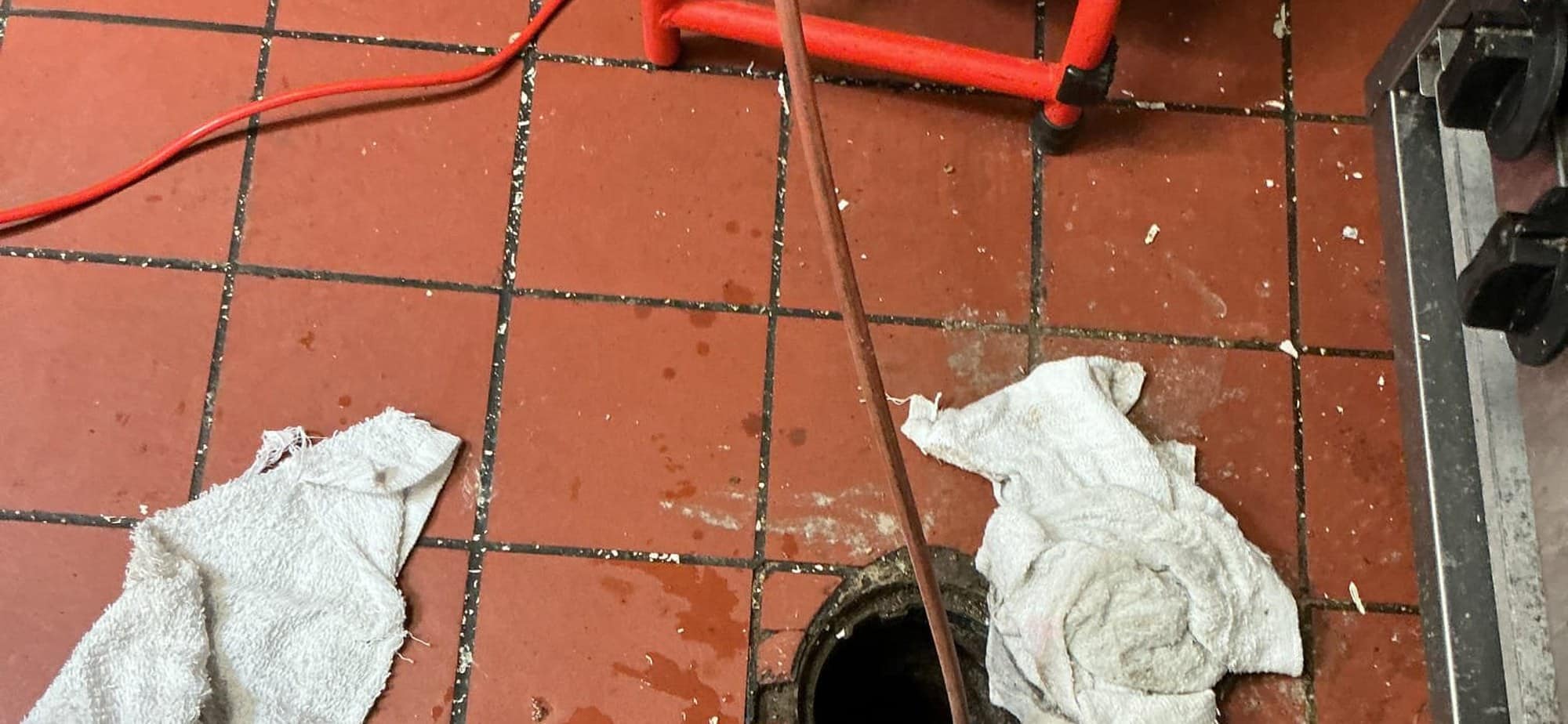
Floor drains in commercial kitchens, laundry facilities, auto service bays, and other commercial spaces are designed to handle water and sometimes other materials. But they’re also among the most neglected components in commercial plumbing.
Floor drains accumulate debris, sediment, and in food-service environments, food particles and grease. They also require their traps to stay filled with water to maintain the seal against sewer gas entering the facility. In areas where floor drains are rarely used (storage rooms, utility areas), the trap can evaporate dry over months, allowing sewer odors to enter.
A basic floor drain maintenance program includes:
- Periodic cleaning of the drain body and strainer basket
- Trap primer maintenance to keep traps filled in low-use drains
- Inspection for cracked or damaged drain bodies
- Annual camera scope to check the condition of floor drain lines in older facilities
High-Traffic Restrooms
Restroom drains in commercial buildings handle a volume of use that residential systems are not designed for. The primary failure modes are toilet clogs (often from improper materials being flushed), urinal drain blockages from mineral and uric scale buildup, and floor drain clogs from paper, debris, and cleaning products.
Mineral and uric scale in urinal drain lines is a specific commercial challenge. The scale forms from mineral content in the water and uric acid from use, building up inside the drain line and creating a hard deposit that restricts flow. Standard drain cleaning doesn’t remove it effectively. Specialized enzymatic treatments or descaling chemicals are required, and in severe cases, hydro-jetting with a descaling agent.
If your facility’s restroom urinals are draining slowly and standard drain cleaning doesn’t help, uric scale is likely the cause.
The Case for Preventive Drain Maintenance
Reactive drain maintenance means calling a plumber when something is already blocked, disrupted, or backed up. In a commercial setting, this often means calling on an emergency basis, which costs more and occurs at the worst possible time, like before the lunch rush or during a business event.
Preventive maintenance means scheduling regular drain cleaning, inspection, and hydro-jetting on a calendar basis before problems develop. The cost is predictable, the timing is yours to choose, and the work prevents the expensive emergency calls.
For most commercial operations, a preventive program includes:
- Quarterly or semi-annual hydro-jetting of main kitchen drain lines (for food service)
- Annual hydro-jetting of other high-use drain lines
- Camera inspection of main sewer lines every 2 to 3 years to assess interior condition
- Regular grease interceptor service
- Urinal drain treatment program
The right frequency depends on your operation type, building age, and drain system configuration. A plumber who works with commercial accounts can assess your facility and recommend a realistic program.
What a Commercial Drain Camera Inspection Shows
Camera inspections for commercial drain lines tell you more than whether the drain is flowing. They show the interior condition of the pipe: scale buildup thickness, root intrusion, offset joints, corrosion, and any sections showing early signs of failure.
For an older commercial building, this information is particularly valuable because it reveals which drain lines are in good shape and which are candidates for problems before those problems become emergencies. Some building owners do a baseline camera inspection when they take over a property to understand what they’re working with. Others schedule inspections every two to three years as part of a maintenance program.
Camera footage can also be documentation. If a drain backup causes damage or a tenant complaint, having maintenance records including camera inspection reports demonstrates due diligence and supports insurance claims.
When to Call
For many Salt Lake businesses, drain problems are noticed as slow-draining fixtures, gurgling sounds from drains, or occasional minor backups. These are early warnings, not emergencies yet. They’re also the right time to call, before a minor restriction becomes a complete blockage.
A camera scope of an early-warning drain line takes an hour and tells you exactly what you’re dealing with. It’s far less expensive than emergency service during operating hours with water on the floor.
Where Rare Breed Fits on Commercial
I’ll be straight with you about where we are with commercial work, because honesty is the whole point of how we run this company. We built our name on residential service across the Wasatch Front, and we’re dipping our toes into commercial right now rather than claiming we’ve done it for decades. It started the way the best parts of this business usually do, with one of our own people. I had a plumber who’s an absolute killer at his craft, and when I asked him what kind of work he wanted to grow into, he told me commercial. So I’m out finding those jobs and helping him build that department, one step at a time. What that means for you as a Salt Lake business owner is real, careful attention from people who want this work, not a job number passed down a corporate chain. If we’re not the right fit for a particular commercial project, we’ll tell you that too.
At Rare Breed Plumbing, Heating, and Air, we provide commercial plumbing services including drain maintenance, hydro-jetting, and camera inspection throughout Salt Lake, Davis, Utah, Weber, Summit, Tooele, Wasatch, Cache, and Box Elder counties. We work around your operating schedule to minimize disruption. Call 385-449-0144 or schedule a commercial service visit.
FAQ
Why do commercial drains fail faster than house drains?
Volume and load. A restaurant line sees thousands of gallons a day. The waste is grease, food, chemicals, and mineral, not just household water.
What does a grease interceptor do?
It sits between the kitchen and the sewer, catches grease, and lets cleaner water through. Food-service shops that discharge cooking grease are required to have one, and it has to be pumped on a schedule.
Why isn’t snaking enough on a restaurant line?
Grease cools, coats the pipe, and catches solids until the line narrows shut. Periodic hydro-jetting of kitchen lines removes the residue a trap does not catch.
What is at stake if a commercial drain backs up?
It can stop operations, create health-code trouble, and empty the building. Without a maintenance plan the question is when, not if.
Related: Drains & Sewer | Commercial Plumbing | Hydrojetting | Sewer Camera Inspection
Related Reading
Related Articles
How We Quote Commercial Plumbing in Utah
By Court Lundberg A commercial quote that is only a phone number and a shrug…
[ READ MORE ]

Does Your Utah Home Need Balanced Ventilation?
By Court Lundberg A tight house keeps the heat you paid for. It also keeps…
[ READ MORE ]

Filtration Sized to Your HVAC System
By Court Lundberg “Filtration sized to your system” is not a catalog upgrade. It is…
[ READ MORE ]